Questions & answers
Bhutan weather, before you ask
The short version
Where the big answers live
The questions with whole pages behind them are answered there: when to visit, whether it snows, what the monsoon really means, why Paro flights bend to the weather, when each trek is walkable and which festival gets which sky. Everything else travellers ask us is below.
Bhutan weather FAQ
Is Bhutan too cold to visit in December or January?
No. Valley winters are dry and sunny — Thimphu still reaches about 15 °C on a January afternoon, though nights drop below freezing. Punakha, at 1,242 m, records no frost at all in its climate normals, which is why winter itineraries pair it with Thimphu. In exchange for cold nights you get the clearest Himalaya views of the year.
What should I pack for Bhutan?
Layers, whatever the month — the day–night temperature swing is large year-round, and a Thimphu winter day can be 17 °C warmer than the night that follows. Add a warm jacket from November to February, rain gear from June to September, and clothing that covers shoulders and knees for dzong and temple visits. Sturdy walking shoes earn their place in any season.
Does it rain every day during the monsoon?
No — and where you are matters enormously. Thimphu averages 19 rain days in July (153 mm), while Phuentsholing on the southern border gets 963 mm the same month — more than Thimphu receives in a whole year. In the western valleys the rain also tends to fall late afternoon and overnight, so mornings are often workable. Our monsoon and rainfall guide covers the full trade-off.
Do monsoon rains cause road blocks or flight delays?
Both. Nearly all of Bhutan’s road blockages happen during the monsoon, with the Phuentsholing–Thimphu highway the most landslide-prone corridor in the country, and Paro’s visual-only approach means valley cloud can hold or divert flights. From June to September, fly rather than drive up from the border, book morning flights and keep a buffer day — the Paro flights and weather guide explains the mechanics.
Umbrella or rain jacket?
Both, in monsoon. An umbrella covers town strolls and temple visits; a proper rain shell is for hikes, where wind and rough trails make umbrellas useless. Outside June–September, a packable shell alone is plenty.
Are there leeches during the monsoon?
On lower forested trails, yes — not in towns or at the main valley-floor sights. They’re a June-to-September, wet-forest problem, handled with boots, leech socks and rain gear. Skip low forest hikes in peak monsoon and you may never meet one.
Is Bhutan cold because it’s in the Himalayas?
It’s elevation, not latitude — Bhutan sits at roughly the same latitude as Florida. The country spans 97 m to 7,570 m, and measured station data shows temperatures drop roughly 5 °C for every 1,000 m you climb. That’s how subtropical Phuentsholing and the alpine Chele La pass fit inside a single day’s drive.
Which months have the clearest mountain views?
October to February, with October–November the sweet spot of clarity plus comfortable temperatures. Mornings — roughly 8 to 10 am — are the clearest window year-round. From Dochula pass on a clear winter day you can see Gangkhar Puensum, Bhutan’s highest peak at 7,570 m.
Can you hike Tiger’s Nest in rain or winter?
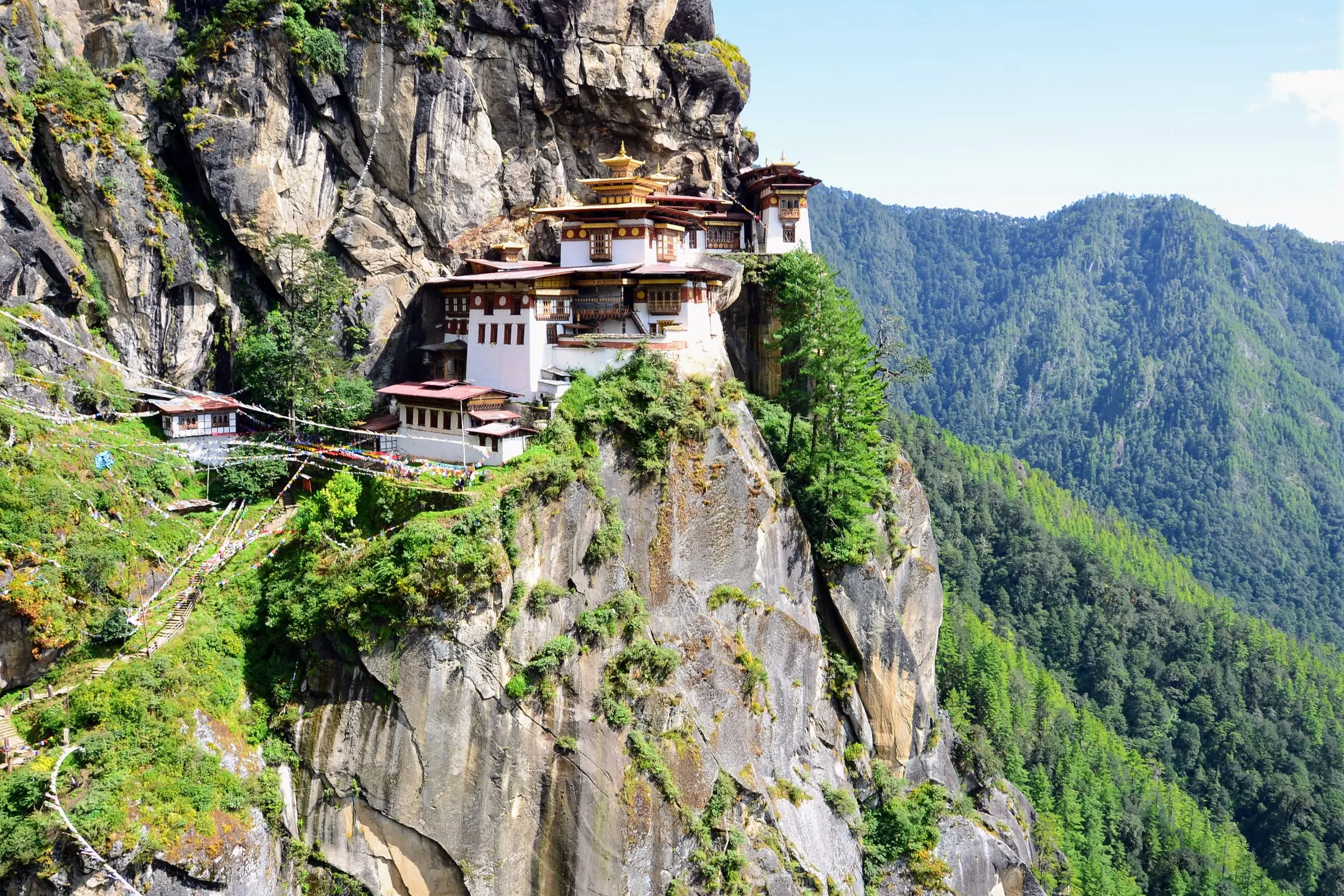
Yes, on all but heavy-rain or heavy-snow days, when the trail can close. The round trip takes four to six hours, and the 700-plus stone steps near the gorge get genuinely slippery when wet, with icy patches on winter mornings — allow extra time rather than counting on a normal pace. Spring and autumn remain the comfortable defaults.
Can you see Tiger’s Nest with snow?
A few times most winters — the monastery sits at about 3,120 m, high enough to catch dustings the Paro valley floor misses. It photographs superbly against clear winter skies, but heavy-snow days can close the trail, so give a winter hike a fallback day. Our snow guide covers where and when it snows across the country.
Do I need trekking boots for Tiger’s Nest?
No — broken-in walking shoes with decent grip are enough for the maintained trail. A pole helps on the long descent, and on winter mornings grip matters more than ankle height. Save the real boots for multi-day treks.
Which season has the fewest tourists?
Summer (June–August) and winter (December–February). Both bring discounted hotels and easier bookings — note that the Sustainable Development Fee is flat year-round, so the savings come from rooms and flights, not the fee. Winter is the underrated pick: clear skies and mild days in the low valleys, at the cost of freezing nights.
Do hotels and farmstays have heating?
In towns, yes — electric heating is widespread. Rural farmhouses and lodges traditionally rely on bukhari wood stoves, which are common in tourist lodging but not universal, so confirm heating and hot water when booking a rural stay for December–February.
Should I worry about altitude sickness?
For the standard cultural circuit, the risk is mild: the main tourist valleys sit between 1,242 m (Punakha) and about 2,900 m (Phobjikha), where most visitors notice nothing worse than breathlessness on stairs. Acclimatise for two or three days before day-hiking higher — Tiger’s Nest tops out around 3,120 m — and treat trekking passes near 5,000 m as a different, serious category that your guide will plan acclimatisation around.
When do the black-necked cranes arrive in Phobjikha?
They arrive in the Phobjikha valley from late October and stay until mid-February, with peak numbers in December and January. The Black-Necked Crane Festival at Gangtey Monastery is one of the calendar’s two fixed dates: 11 November, every year.
Still deciding on a season?
Ask Little Bhutan’s local team — they live in this weather, and they’ll tell you straight which month fits the trip you have in mind.
Plan Your Trip Read the Bhutan travel guide
Trips arranged by Little Bhutan · locally owned & operated