The honest take
Bhutan’s monsoon, honestly
Bhutan’s monsoon runs June to September and delivers more than 70 % of the year’s rain, with onset normally declared around 5 June. In the western tourist valleys the rain falls mostly in the late afternoon and overnight, leaving mornings usable. It suits a cultural trip; the high treks are off-season.
The verdict
Is a monsoon trip worth it?
For a cultural trip — dzongs, temples, valley towns — yes, with open eyes. The valleys are at their greenest, the big sights are quiet, and hotels discount their empty rooms. For trekking, no: the high routes are off-season, full stop. And whatever your plans, monsoon is the one season where you should build slack into the itinerary, because the rain doesn’t just fall on you — it falls on the roads and the flight schedule.
The mechanics
How Bhutan’s monsoon works
The southwest monsoon arrives from the Bay of Bengal in early June — Bhutan’s National Center for Hydrology and Meteorology (NCHM) formally declares onset each year, and the normal date is 5 June. The season runs June to September, and NCHM puts more than 70 % of the year’s rainfall inside those four months.
The daily rhythm matters as much as the totals. In the western tourist valleys (Paro, Thimphu, Punakha), guides and operators consistently report the same pattern: rain falls mostly in the late afternoon and overnight. Mornings are often dry or merely grey — which is why a well-run monsoon itinerary front-loads each day and treats the afternoon as flexible.
The gradient
“Rainy season” means wildly different things by valley
Bhutan’s rainfall gradient is extreme. Thimphu records about 609 mm a year — drier than London. Phuentsholing, on the southern border, records about 3,953 mm, and its July alone (963 mm) out-rains Thimphu’s entire year. The inner valleys you actually tour sit in a partial rain shadow; the subtropical foothills take the full monsoon. Phobjikha, a high side-valley that catches the flow the west valleys miss, lands in between.
| Town (elevation) | Jun | Jul | Aug | Sep | Year |
|---|---|---|---|---|---|
| Thimphu (2,321 m) | 98 mm | 153 mm | 121 mm | 74 mm | ≈609 mm |
| Paro (2,266 m) | 81 mm | 161 mm | 113 mm | 88 mm | ≈631 mm |
| Punakha (1,242 m) | 143 mm | 158 mm | 148 mm | 101 mm | ≈786 mm |
| Phobjikha (2,900 m) | 268 mm | 516 mm | 530 mm | 211 mm | ≈2,228 mm |
| Bumthang (2,587 m) | 98 mm | 156 mm | 139 mm | 89 mm | ≈760 mm |
| Phuentsholing (293 m) | 807 mm | 963 mm | 779 mm | 493 mm | ≈3,953 mm |
Monthly precipitation normals, NCHM Climate Data Book of Bhutan 2018 (station periods 1996–2017/18).
The upside
What a monsoon visit is actually like
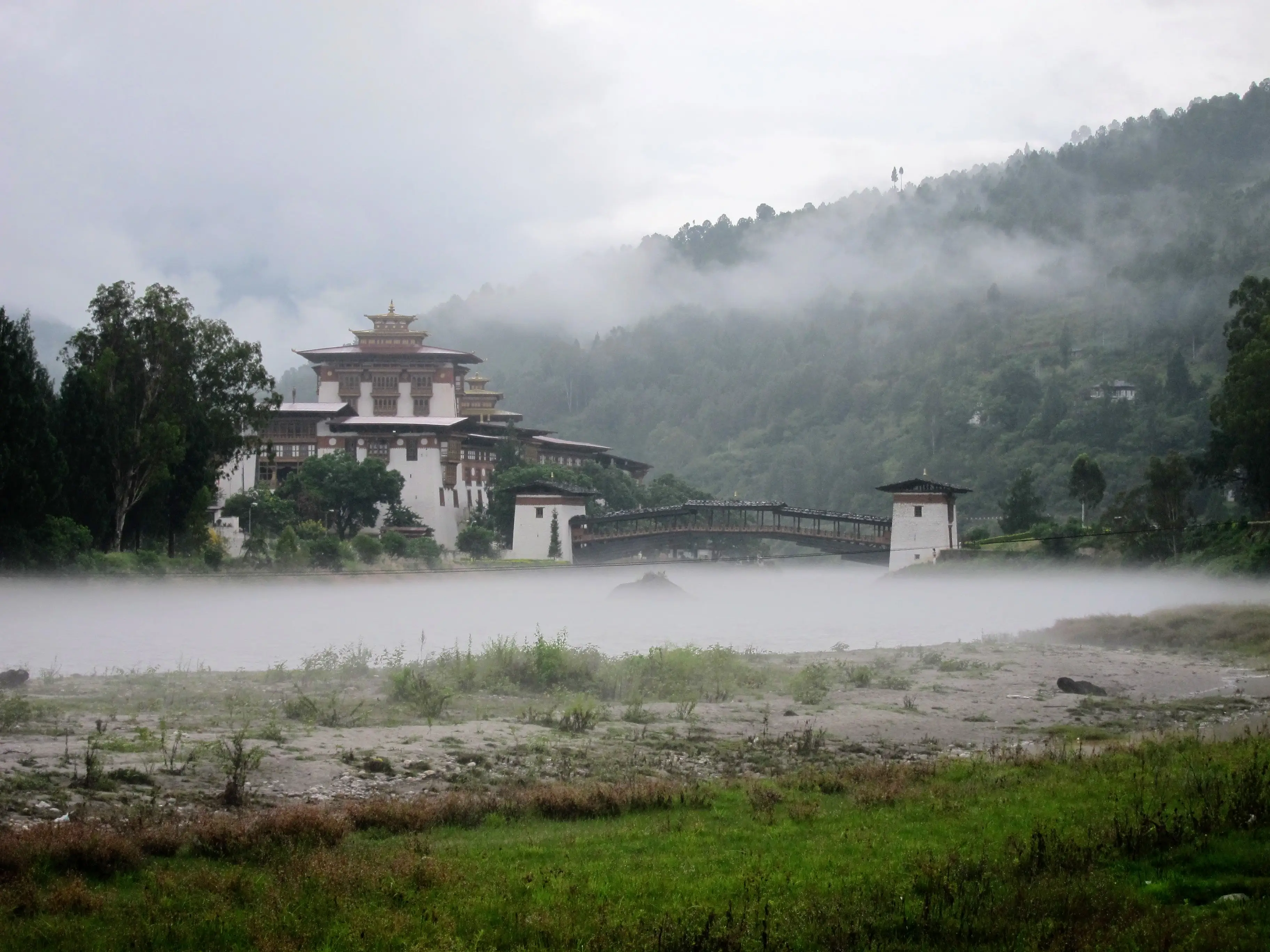
July is when the rice paddies of Punakha and Paro are at their most intensely green — the postcard-Bhutan landscape exists because of these rains. The festival crowds of spring and autumn are gone: you can have a dzong courtyard nearly to yourself, and photographers get moody cloudscapes instead of flat blue skies. Hotels and flights discount, and the best guides are actually available. (Bhutan’s Sustainable Development Fee is flat year-round — the savings come from rooms and airfares, not the fee.)
The costs
The honest costs — roads, flights, leeches, treks
Landslides on the southern highway
The Phuentsholing–Thimphu highway — the main overland entry route — is the most landslide-prone road corridor in the country. A peer-reviewed study recorded 269 landslides on the 90 km Phuentsholing–Chhukha stretch between 1998 and 2015. Road-department figures reported by Kuensel show 98 % of road blockages happen in the monsoon window, and monsoon closures on that reporting averaged 6.67 days against a third of a day in the dry season. Multiple simultaneous blocks have stranded travellers between slides. If you can fly in rather than drive up from the border in July, fly.
Paro flight holds
Paro’s approach is flown visually, so monsoon cloud sitting in the valley can hold or divert flights — Drukair’s own conditions of carriage make the schedule officially weather-dependent. The mechanics, and what to do about them, are on the Paro flights & weather page; the short version is book morning flights and keep a buffer day.
Leeches
Monsoon is leech season on lower forested trails — not in towns, not at valley-floor sights. Boots, leech socks and rain gear handle them; skipping low forest hikes in peak monsoon avoids them entirely.
Trekking is off
High routes are closed for the season in practice: trails turn to mud, passes sit in cloud, and rivers run high. If a trek is the point of your trip, this is simply the wrong season — see the trekking weather windows for when each route opens.
Thinking about a green-season trip?
Little Bhutan runs monsoon itineraries with the buffer days already built in — morning flights, flexible afternoons and no southern highway in July.
Plan Your Trip Read the Bhutan travel guide
Trips arranged by Little Bhutan · locally owned & operated