Bhutan month by month
Bhutan in August
Bhutan in August is the monsoon’s long exhale. Rain eases slightly from the July peak in Thimphu and Paro but still falls on most days, while the high Phobjikha valley records its wettest month of the year. Landscapes reach maximum lushness, and September’s festivals are within reach.
- Thimphu day / night
- 27° / 16°
- rain over the month (Thimphu)
- 121 mm
- rain days on average
- 16.7
- Punakha daily high
- 30°
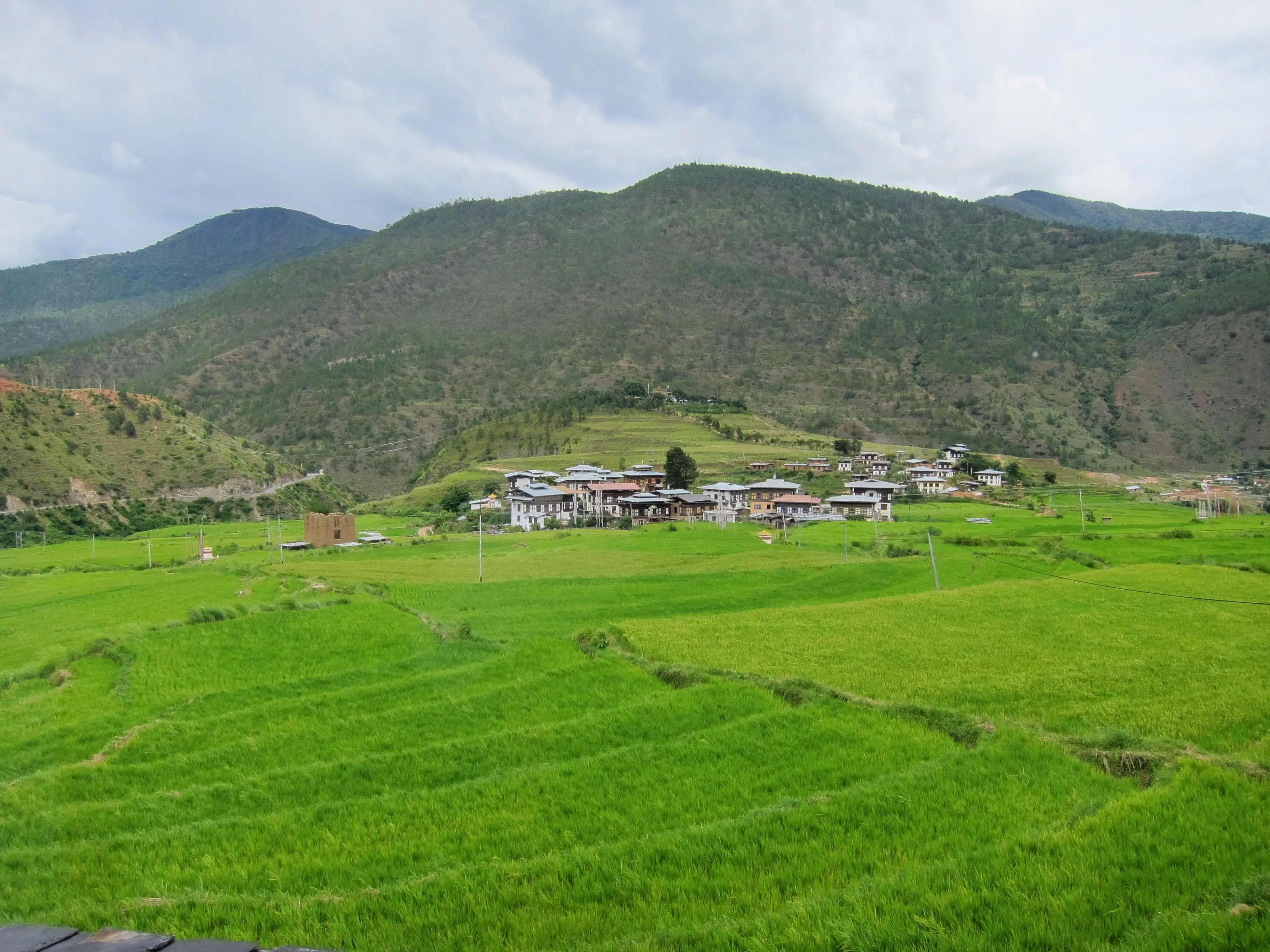
August is the monsoon’s long exhale. In the western valleys the rain gauges start their slow retreat from the July peak, but the season is far from over — and in the high catchments like Phobjikha it is still at full strength. The landscape, meanwhile, is at maximum lushness: full rivers, saturated greens, waterfalls on every hillside.
Weather
August weather, valley by valley
Daily high °C Nightly low °C Rainfall mm
Where August sits in Thimphu’s year — the reference station. The full six-town numbers:
| Town | Elevation | High °C | Low °C | Rain mm | Rain days |
|---|---|---|---|---|---|
| Thimphu | 2,321 m | 27.3 | 16.1 | 121 | 16.7 |
| Paro | 2,266 m | 24.9 | 15.7 | 113 | 17.4 |
| Punakha | 1,242 m | 30.4 | 20.6 | 148 | — |
| Phobjikha | 2,900 m | 20.3 | 11.4 | 530 | — |
| Bumthang | 2,587 m | 22.7 | 14.2 | 139 | 19.6 |
| Phuentsholing | 293 m | 32.3 | 23.8 | 779 | — |
Station climate normals from the NCHM Climate Data Book of Bhutan, 2018 (1996–2017/18). Rain-day counts are not published for every station.
The table shows a tail-heavy season. Thimphu and Paro record slightly less rain than in July, though still rain on most days, warm and humid throughout. But look at Phobjikha: the high glacial valley posts its wettest month of the year in August — the monsoon does not fade evenly across the country, and the higher, more exposed valleys hold onto it longest. Phuentsholing remains in another climate altogether, still receiving in a month what Thimphu gets in a year.
The daily rhythm holds: valley rain still falls disproportionately in the late afternoon and overnight, keeping mornings usable. Mountain views remain rare treats between cloud banks.
Crowds & costs
How busy — and how pricey — is August?
Still deep low season — the same quiet dzongs, discounted hotels and easy availability as July, before the September festival crowd arrives. The SDF is unchanged, as in every month; the low-season economics are entirely about rooms and airfares.
Festivals
Festivals in August
- No major tshechus fall in August — but the wait is nearly over: Thimphu Tshechu and Wangdue Tshechu open the autumn season in September.
⚠️ Tshechu dates follow the lunar calendar and shift every year — only the Black-Necked Crane Festival (11 Nov) and Dochula Druk Wangyel (13 Dec) are fixed. Confirm final dates on bhutan.travel before you book.
What to do
What August is for
The rice terraces remain the star — Punakha’s and Paro’s paddies stay in their deepest green through August before the slow turn towards autumn gold. It is a fine month for the quieter cultural circuit: weaving workshops, farmhouse meals, hot-stone baths, riverside dzongs with the rivers at their most dramatic.
The cautions are July’s, unchanged: high treks are off-season, lower forest trails carry leeches, and the monsoon remains the peak period for road blockages — the border highway from Phuentsholing is the worst corridor, so fly into Paro where possible, favour morning flights and pad your connections. Towards the very end of the month, the first hints of post-monsoon clearing can appear.
Packing
What to pack for August
As for July: shell and umbrella, quick-dry layers, grippy waterproof footwear, dry bags, repellent. Add a light warm layer if Phobjikha or Bumthang are on the route — high-valley evenings cool noticeably even in late summer.
The verdict
Should you visit Bhutan in August?
August suits the same traveller as July — culture-first, flexible, happy to trade views for greenness and quiet — with the small bonus that the west is slowly drying and September’s festivals are within reach of a longer itinerary. Trekkers should still wait.
Found your season? Plan the trip.
Little Bhutan is a locally owned operator that builds your itinerary around the weather — guide, permits, government fees and hotels included.
Plan Your Trip Read the Bhutan travel guide
Trips arranged by Little Bhutan · locally owned & operated