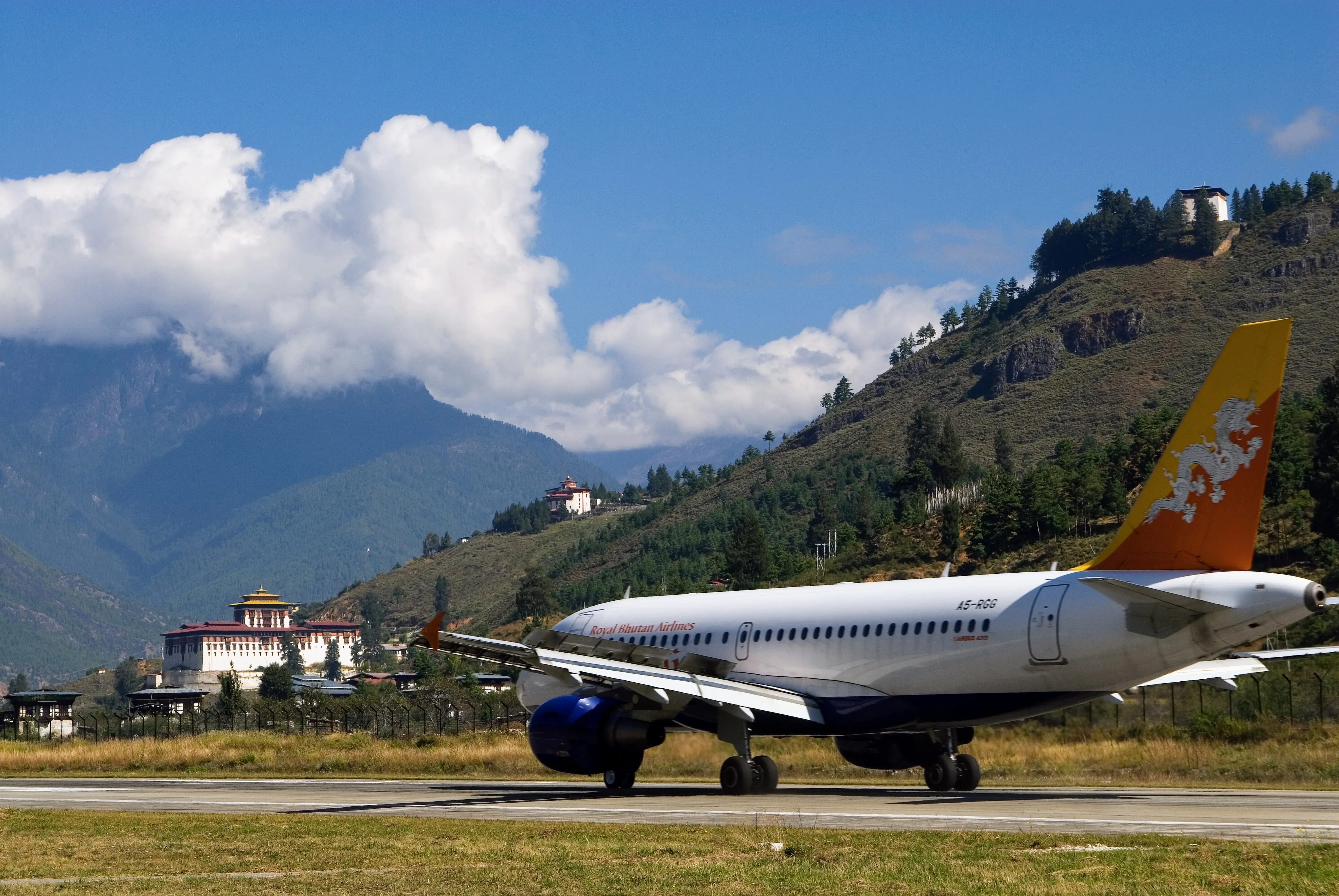
The airport the weather runs
Paro flights & the weather
Flights into Paro, Bhutan’s only international airport, are flown by eye in daylight down a Himalayan valley, with no instrument landing system. Weather therefore decides the schedule. Book the morning flight, before the valley winds build, and never plan a tight onward connection — keep a buffer day.
The two rules
Book the morning flight, keep a buffer day
Paro is one of the few international airports on Earth where the weather doesn’t just delay flights — it defines how the airport works at all. Every arrival is flown by eye, in daylight, down a winding Himalayan valley. That makes two pieces of advice worth more than any forecast: fly in the morning, before the valley winds pick up, and never book a tight onward connection. The rest of this page is why.
The approach
Why Paro is different
The airport sits at 2,235 m on the floor of the Paro valley, surrounded by peaks rising to about 5,500 m. There is no ILS — the instrument landing system that lets airliners descend through cloud onto a straight final almost anywhere else — and only a single VOR radio beacon. Operations are restricted to daylight hours and visual meteorological conditions: pilots must be able to see the terrain, because the final approach threads between ridges with a banking turn onto a runway that stays hidden until late in the descent.
Paro remains daylight-only, and every landing ends with the pilots hand-flying the final approach visually — though an RNP-AR ‘cloud-break’ instrument procedure now guides aircraft through the valley cloud almost to the point where the pilots take over by eye.
Only a handful of pilots may fly it
Paro is classed as a Category C airport — the designation for airports demanding special crew certification. Per CNN’s October 2024 reporting, captains need 1,500 hours of total flying time, 500 hours of mountain flying, and 30 supervised landings at Paro itself before they can command a flight in. In the same reporting, Drukair’s Capt. Chimi Dorji put the pool at about 50 licensed pilots in Bhutan as of October 2024 — while expecting that number “could easily double in the next few years” as the airlines grow.
The mechanism
Afternoon winds: why morning flights are more reliable
Himalayan valleys breathe on a daily cycle. As the sun heats the valley walls, air rises and draws wind up the valley — so afternoons at Paro are reliably windier and more turbulent than mornings, when the air is cool and still. A visual, hand-flown approach has firm wind limits, which is why schedules cluster in the morning and why the morning departure is the one least likely to be held. When you have a choice, take the earliest flight of the day — in both directions.
Monsoon: when the valley fills with cloud
From June to September the problem shifts from wind to visibility. Monsoon cloud and rain can sit in the approach valley for hours; since the crew must complete the final approach by eye, flights hold, delay, or divert until it lifts. This isn’t an edge case — Drukair’s own conditions of carriage make the schedule officially weather-dependent, with timings subject to change without notice. When aircraft can’t get in, they commonly divert to Kolkata or Bagdogra in India (as widely reported by travellers) and complete the trip once Paro opens.
You may see confident “30–60 % of monsoon flights divert” figures circulating online. None trace to a published source, so we don’t repeat them — the mechanism above is the reliable part. For what the season means on the ground, see monsoon & rainfall.
The playbook
How to plan around it
- Fly in the morning. Calmer air, better visibility odds, and more of the day left for recovery if things slip.
- Leave at least 24 hours for international connections. That’s Drukair’s own recommendation, not ours — a same-day connection through Bangkok, Delhi or Kathmandu is a bet against the weather.
- Add a buffer day from June to September. One spare day absorbs nearly any monsoon hold or diversion; without it, a delayed flight cascades through the whole trip.
- Window seat, left side flying in — on a clear day the Himalaya line up outside, and the valley approach itself is one of the trip’s sights.
None of this makes Paro risky — its safety record rests precisely on refusing to fly when the valley says no. It just makes the schedule honest about who’s in charge.
Let someone local watch the weather
Little Bhutan books the morning flights, pads the connections and rebuilds the plan for you if the valley clouds over — that’s the point of a local operator.
Plan Your Trip Read the Bhutan travel guide
Trips arranged by Little Bhutan · locally owned & operated