Bhutan month by month
Bhutan in April
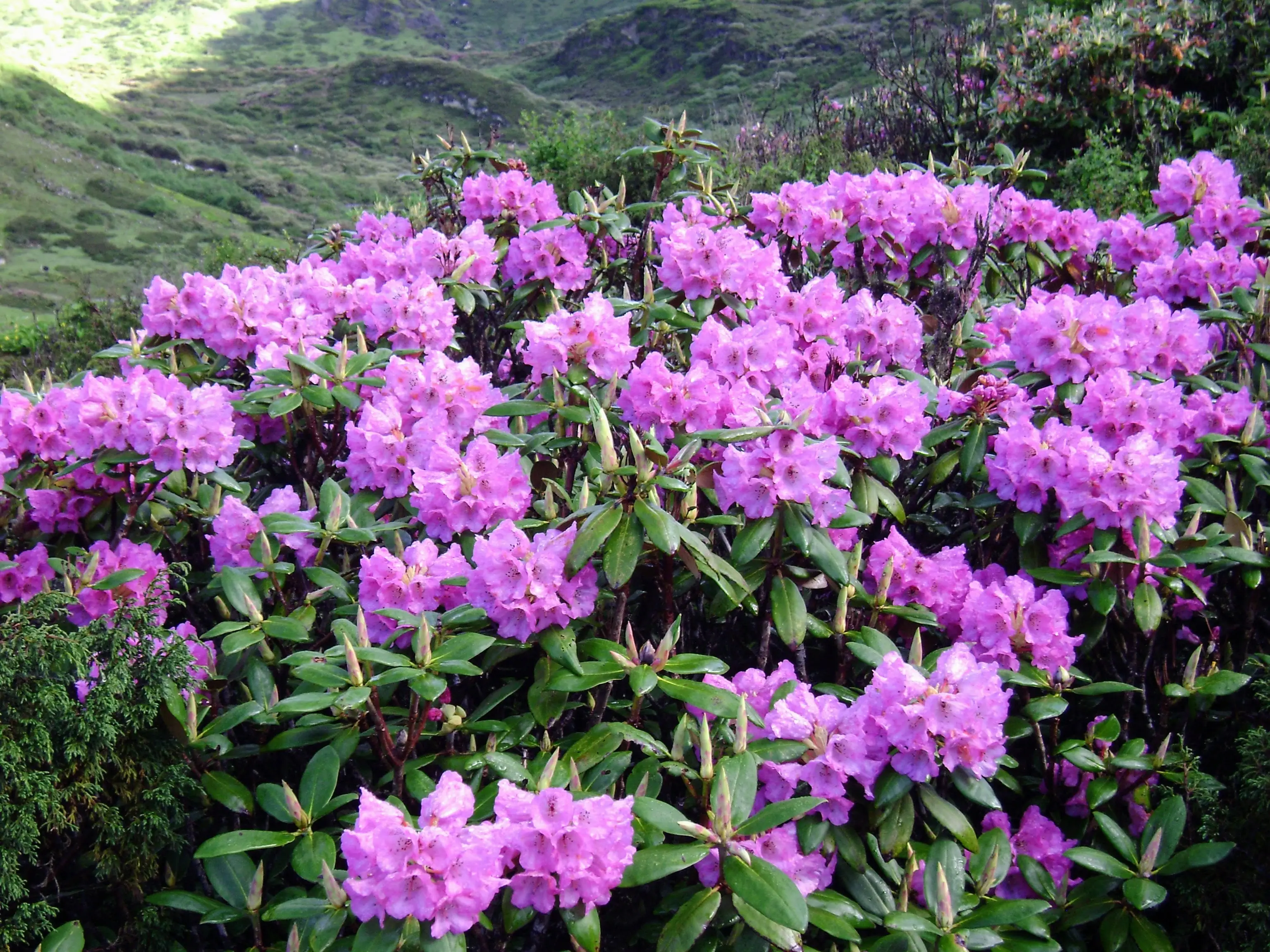
Bhutan in April is peak spring: rhododendron forests in full bloom, warm valley afternoons, mild nights, and one of the two best trekking windows of the year. Rain is building but still amounts to a handful of showery days in the west. It is also one of Bhutan’s busiest months.
- Thimphu day / night
- 22° / 8°
- rain over the month (Thimphu)
- 30 mm
- rain days on average
- 6.2
- Punakha daily high
- 27°
April is peak spring — the rhododendron forests at full bloom, warm valley days, and one of the two best trekking windows of the year. It is also one of Bhutan’s busiest months, second only to May in recent arrival statistics, so it pairs the best conditions with the most company.
Weather
April weather, valley by valley
Daily high °C Nightly low °C Rainfall mm
Where April sits in Thimphu’s year — the reference station. The full six-town numbers:
| Town | Elevation | High °C | Low °C | Rain mm | Rain days |
|---|---|---|---|---|---|
| Thimphu | 2,321 m | 22.4 | 7.9 | 30 | 6.2 |
| Paro | 2,266 m | 20.6 | 7.8 | 34 | 6.4 |
| Punakha | 1,242 m | 26.8 | 14.4 | 44 | — |
| Phobjikha | 2,900 m | 15.8 | 2.8 | 189 | — |
| Bumthang | 2,587 m | 17.5 | 5.9 | 67 | 12.3 |
| Phuentsholing | 293 m | 31.1 | 20.1 | 217 | — |
Station climate normals from the NCHM Climate Data Book of Bhutan, 2018 (1996–2017/18). Rain-day counts are not published for every station.
The normals show every valley in its most comfortable range: warm afternoons, mild nights, and rain that is picking up but still amounts to only a handful of wet days in the west — brief showers rather than settled rain. Punakha is heading towards hot; Bumthang and Phobjikha are at their green, fresh best.
The trade-off is visibility. Spring haze builds through April, so while day-to-day weather is excellent, the odds of a razor-sharp Himalaya panorama are lower than in autumn or winter — treks that climb above the haze layer are the reliable way to earn the big views this month.
Crowds & costs
How busy — and how pricey — is April?
Full high season. April is consistently among the very busiest months of the Bhutanese year in official arrival figures — the spring peak is real, and hotels, guides and Paro flights all run at maximum demand. Book flights and rooms months out. The SDF is unchanged (it is flat in every season); it is everything around it that gets scarce.
Festivals
Festivals in April
- Paro Tshechu — the festival’s final days can spill into early April (in 2026 it ran to 2 April, ending with the dawn Thongdrol). In other years it falls entirely within March or later in April — the lunar calendar moves it substantially.
⚠️ Tshechu dates follow the lunar calendar and shift every year (2026 dates shown, verified July 2026) — only the Black-Necked Crane Festival (11 Nov) and Dochula Druk Wangyel (13 Dec) are fixed. Confirm final dates on bhutan.travel before you book.
What to do
What April is for
Two seasonal headliners. First, the bloom: April is the rhododendron peak in the temperate and subalpine forests, and the Lampelri Botanical Park below Dochula — with 29 species growing naturally and around 40 on display — is the easy showcase. Second, the trails: April is one of the two best months for the Jomolhari trek (the other is October), crossing high passes near 4,900 m through flowering hillsides, and the Druk Path is in mid-window.
Lower-key pleasures match the season too: Paro valley orchards and fresh-planted fields, comfortable Tiger’s Nest conditions, and long warm evenings in Punakha.
Packing
What to pack for April
Spring layers plus real trekking kit if you are heading high: warm layers and a proper shell for passes that can still see snow flurries, lighter clothing for the valleys, and rain protection for the odd shower. Sun protection matters everywhere at this latitude and altitude.
The verdict
Should you visit Bhutan in April?
If flowers and high trails are your Bhutan, April is the month — arguably the finest all-round conditions of the spring. Just come resigned to sharing it: this is peak season in fact, not just in brochures, and the mountain views carry a haze asterisk that autumn does not.
Found your season? Plan the trip.
Little Bhutan is a locally owned operator that builds your itinerary around the weather — guide, permits, government fees and hotels included.
Plan Your Trip Read the Bhutan travel guide
Trips arranged by Little Bhutan · locally owned & operated