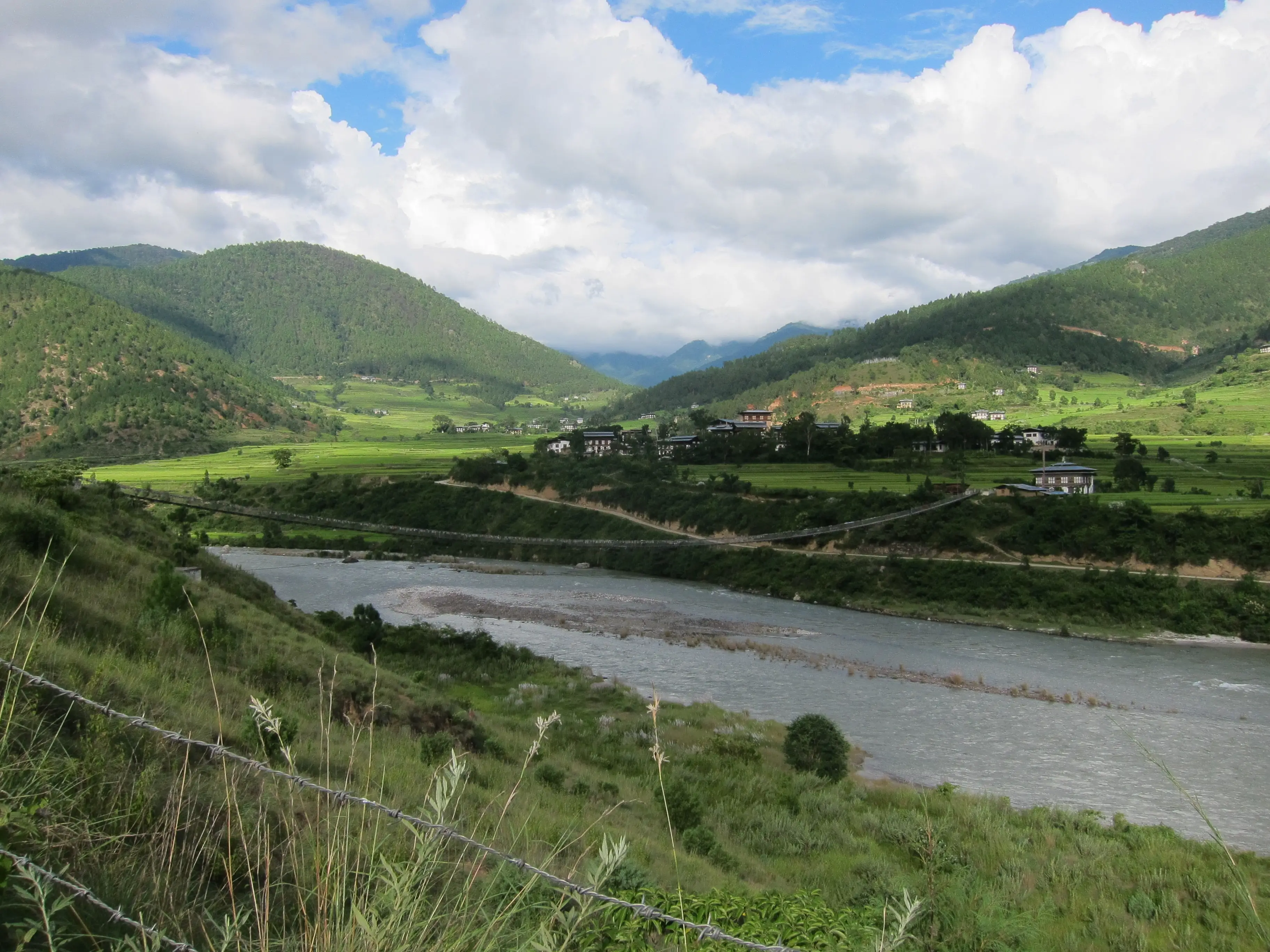
Bhutan town by town · western Bhutan, 1,242 m
Punakha weather
Punakha lies at 1,242 m, roughly 1,000 m below Thimphu, and it is the warm one. Its normals record no frost at all: January days reach the high teens in °C. Summers are genuinely hot and it is Bhutan’s rice bowl. This is why winter itineraries pair Punakha with the capital.
- elevation
- 1,242 m
- warmest day · July
- 31°
- coldest night · January
- 6°
- rain per year
- 786 mm
The valley
What Punakha is actually like
Drop out of Thimphu over the Dochula pass and down the far side, and the climate changes underneath you inside two hours. Punakha is the clearest demonstration on the site of Bhutan’s central rule: elevation, not latitude, decides the weather.
At roughly 1,000 m lower, the valley is subtropical in feel — rice terraces, river confluences, and winters mild enough that Bhutan’s old winter capital was sited here for exactly that reason.
Month by month
Punakha weather, month by month
Daily high °C Nightly low °C Rainfall mm
| Month | High °C | Low °C | Rain mm | Rain days |
|---|---|---|---|---|
| January | 18.8 | 5.8 | 14 | — |
| February | 20.7 | 7.9 | 22 | — |
| March | 23.9 | 11.2 | 17 | — |
| April | 26.8 | 14.4 | 44 | — |
| May | 28.8 | 17.3 | 85 | — |
| June | 30.5 | 19.9 | 143 | — |
| July | 30.7 | 20.8 | 158 | — |
| August | 30.4 | 20.6 | 148 | — |
| September | 29.3 | 19.4 | 101 | — |
| October | 27.4 | 16.6 | 46 | — |
| November | 23.9 | 11.4 | 5 | — |
| December | 20.2 | 7.3 | 4 | — |
Station climate normals for Punakha from the NCHM Climate Data Book of Bhutan 2018 (1996–2018 station normals). Rain-day counts are not published for every station — see sources & method. The wettest month here is July, at 158 mm.
The striking thing in the table is the January row: no frost in the normals, and daytime highs that would pass for spring in the higher valleys. The trade is at the other end of the year, when summer highs climb into the low thirties and the humidity arrives with the monsoon.
Rainfall is heavier than Thimphu’s across the year, concentrated hard into June through September like everywhere else in the western belt.
When to come
The best time to visit Punakha
December through February is Punakha’s standout window and the reason it appears in almost every winter itinerary: warm afternoons by the river while the high valleys are freezing. The Punakha Drubchen and Tshechu fall in this cool, dry stretch — lunar dates shift each year, so reconfirm before booking around them.
High summer is the one period to think twice about, less for the rain than for the heat and humidity in the valley floor.
Live conditions for Punakha and the other five towns are on the Bhutan forecast page, updated hourly. For the country-wide comparison see best time to visit Bhutan, or read Best time to visit Bhutan.
Found your season? Plan the trip.
Little Bhutan is a locally owned operator that builds your itinerary around the weather — guide, permits, government fees and hotels included.
Plan Your Trip Read the Bhutan travel guide
Trips arranged by Little Bhutan · locally owned & operated