Winter, answered
Does it snow in Bhutan?
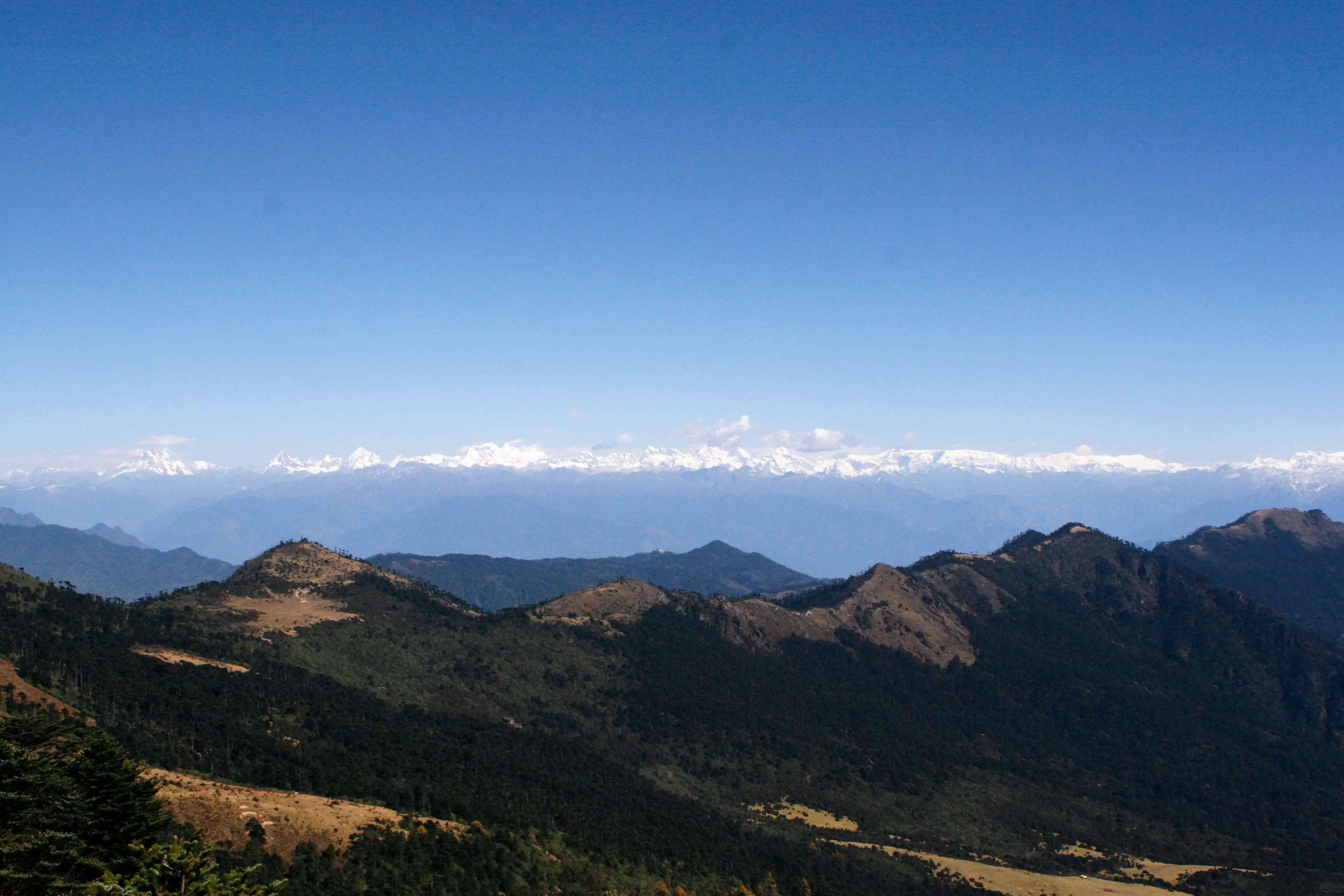
Yes — it snows in Bhutan every winter, but elevation decides where and how often. In the tourist valleys around 2,300 m, such as Thimphu and Paro, snow falls a few times a winter and rarely lingers. On the road passes between 3,100 and 3,988 m it falls frequently from December to February. The northern peaks hold snow year-round.
If you picture Bhutan buried in Himalayan snow, the reality of a valley winter — sunny, dry, freezing only at night — will surprise you.
Where it snows in Bhutan, place by place
Elevation decides everything. Roughly 3,000 m is the line: below it snow falls a few times a winter and melts within a day or two; above it, it falls often from December to February. Snowiest first:
| Place | Elevation | Snow |
|---|---|---|
| The alpine north | above ~4,500 m, to 7,570 m at Gangkhar Puensum | Permanent, year-round. The Bhutan of the postcards — visible from the valleys all winter, but uninhabited and roadless. |
| Chele La (Paro–Haa road) | 3,988 m | The country’s highest motorable pass. Regular winter falls, and temporary closures after heavy snow. |
| Thrumshing La (central–east Lateral Road) | 3,780 m | Winter snow can close it and cut the east–west land link. |
| Tiger’s Nest (Paro Taktsang) | ~3,120 m | Roughly 900 m above the Paro valley floor, so a dusting a few times most winters. The trail can close on heavy-snow days. |
| Dochula (Thimphu–Punakha road) | 3,100 m | Frequent snow December–February, with brief closures in some winters. Its 108 chortens under fresh snow are a winter reward in themselves. |
| Phobjikha (Gangtey) | ~2,900 m | A few falls a winter, as on the other high valley floors. Frost from November and freezing nights through February — the crane valley at its coldest. |
| Bumthang (Jakar) | 2,587 m | A few falls a winter, and the coldest winter nights of the six towns (January low −3.9 °C) between sunny days. |
| Thimphu | 2,321 m | A few snowfalls a winter, usually gone within a day or two. A proper fall has twice closed the capital for the day. |
| Paro | 2,266 m | The same few-times-a-winter pattern, with the lowest winter rain-day count of the six towns — 0.7 wet days in January. |
| Punakha | 1,242 m | None. Its normals show no frost at all, which is why winter itineraries drop down here. |
| Phuentsholing | 293 m | None. The subtropical border town is a different climate altogether. |
Town elevations from Wikidata; Phobjikha and the Tiger’s Nest trail high point are approximate. January figures are NCHM normals — see the table below.
The numbers
What a valley winter actually looks like
Winter in the western valleys is the dry season: Thimphu records just 6 mm of precipitation in January, across roughly one wet day. Days are sunny and mild — mid-teens by afternoon — while nights drop below freezing. That swing, not deep cold, is the character of a Bhutanese winter, and it comes with the year’s clearest Himalaya views.
| Town (elevation) | Jan high | Jan low | Jan precipitation |
|---|---|---|---|
| Thimphu (2,321 m) | 14.8 °C | −2.2 °C | 6 mm |
| Paro (2,266 m) | 13.2 °C | −0.9 °C | 7 mm |
| Punakha (1,242 m) | 18.8 °C | 5.8 °C | 14 mm |
| Phobjikha (2,900 m) | 9.4 °C | −3.5 °C | 4 mm |
| Bumthang (2,587 m) | 11.4 °C | −3.9 °C | 6 mm |
| Phuentsholing (293 m) | 23.9 °C | 13.4 °C | 17 mm |
January normals, NCHM Climate Data Book of Bhutan 2018. The cold extremes live higher up: NCHM’s State of the Climate 2023 logged the national low of −10.5 °C in high-valley Haa, which spends 135 nights a year below freezing.
The tradition
The snow-day holiday
Bhutan may be the only country where the capital’s first proper snowfall has been marked with a government holiday. When Thimphu woke to snow on 21 January 2013, offices closed for the day so people could enjoy it; when heavy snow blanketed the west on 29 December 2021, institutions closed across Thimphu, Paro, Haa, Gasa and Bumthang. Snow is widely held to be auspicious here, and the country has repeatedly decided it is worth downing tools for.
The photograph
Tiger’s Nest under snow
The monastery clings to its cliff at about 3,120 m — roughly 900 m above the Paro valley floor, and correspondingly colder and snowier. A few times most winters it picks up a dusting that transforms the classic view, and because winter skies are so clear, the days right after a fall are prime photography weather. The trade-off: the trail can close on heavy-snow days, and icy patches linger on the stone steps on winter mornings. Put the hike in the middle of a winter itinerary, not on the last day, so a closure costs you nothing.
The passes
Where snow actually disrupts travel
Snow’s real impact on a Bhutan trip is on the high road passes, not in the valleys:
- Dochula (3,100 m), between Thimphu and Punakha, sees brief snow closures in some winters — days, not seasons — and its 108 chortens under fresh snow, with the Himalaya behind, are a genuine winter reward once the road reopens.
- Chele La (3,988 m), on the Paro–Haa road over the country’s highest motorable pass, closes temporarily after heavy falls in deep winter.
- Thrumshing La (3,780 m), on the central–east Lateral Road, is the serious one: winter snow can close it and cut the east–west land link, with public and commercial vehicles barred during closures. If you’re headed to Bumthang or beyond in deep winter, your operator will be watching this pass.
Closures are short and the roads are cleared quickly, but a winter itinerary that crosses passes should carry the same slack a monsoon one does.
Don’t let the snow put you off winter
The standard winter itinerary already routes around the cold: Punakha, 1,000 m lower than Thimphu, has January afternoons near 19 °C and no frost in its normals — which is exactly why its big festivals fall in late winter. Add the clearest mountain views of the year (October to February) and the black-necked cranes wintering in Phobjikha, and December–February is arguably Bhutan’s most underrated season. See the best time to visit for how winter stacks up against the rest of the year.
Tempted by a winter trip?
Little Bhutan builds winter itineraries around the mild valleys, the clear-sky viewpoints and the crane season — with pass conditions watched for you.
Plan Your Trip Read the Bhutan travel guide
Trips arranged by Little Bhutan · locally owned & operated